
Decoding Turing:'Breaking the Code' at Central Square Theater
Review

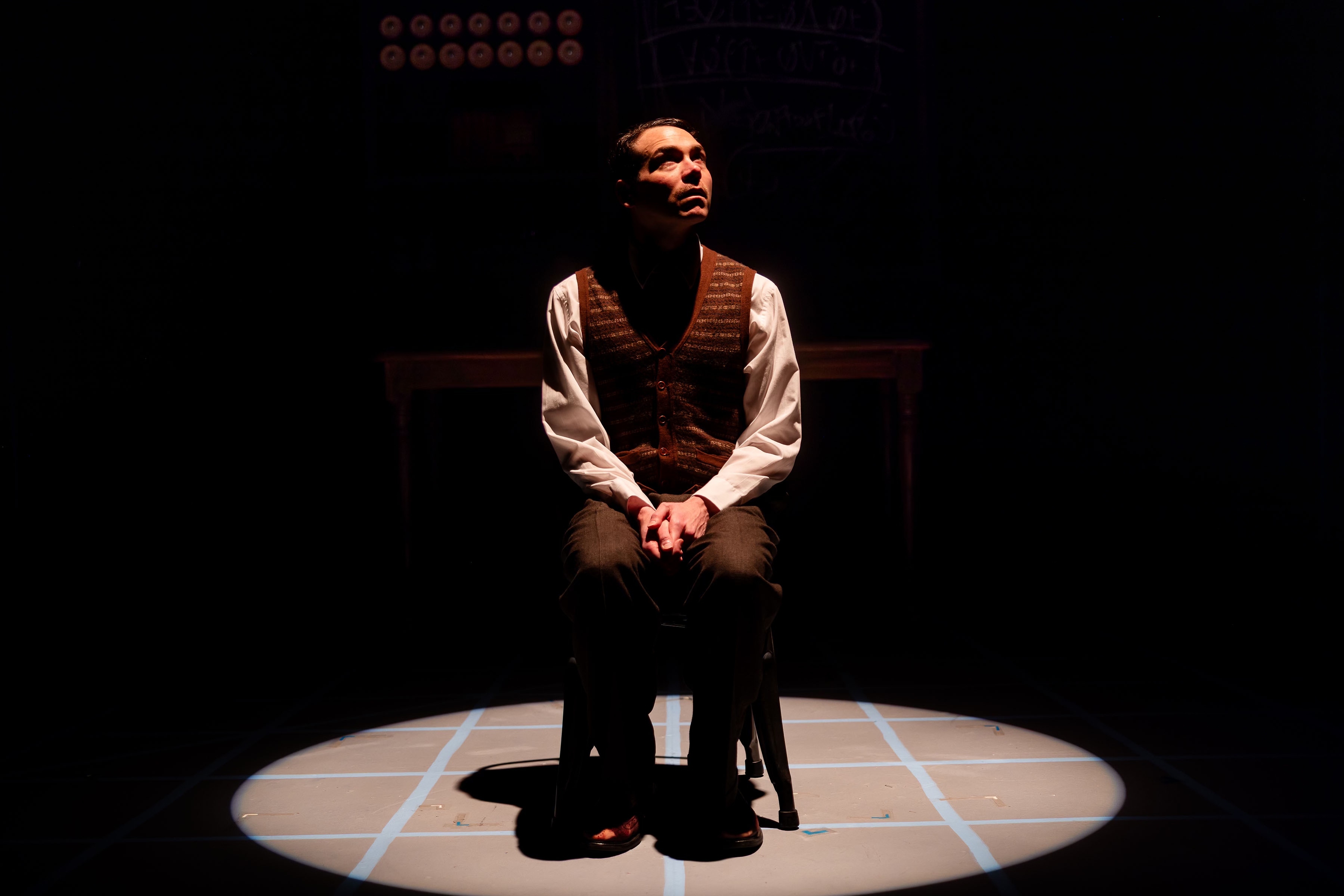
I’ll never forget the first time I watched the 2014 biographical thriller The Imitation Game. Starring Benedict Cumberbatch, it served as my introduction to Alan Turing and his pivotal work. What I found so moving was the recovery of a story that had been long overlooked, discarded into the dustheap of history, all centering on a brilliant gay man. Now, in Central Square Theater’s production of Breaking the Code, we return to Turing’s narrative for another intimate look into his later years following his breakthrough work with the British Government Code & Cypher School.
Breaking the Code is interestingly structured, weaving the past and present through a series of flash-forwards and flashbacks. It uses Turing’s interrogation by British authorities, his subsequent conviction, and his eventual death as a somber anchor point. From this vantage, the play moves through pivotal moments of his childhood, his early days at the cypher agency, the complexities of his burgeoning sexuality, his thrill of learning and questioning, and his internal struggle to exist in a world that was slow to accept him. What follows is a portrait of Turing’s life that offers his legacy a far more humane framing than I had anticipated.
Directed by Scott Edmiston, Breaking the Code opens on a visually intriguing Janie E. Howland set—utilizing shelves stuffed with office supplies and apples (a poignant foreshadowing) and television screens that serve as an unexpected extension of the stage during transitions. This level of mixed-media integration is a hallmark I’ve come to enjoy at Central Square Theater (SeifAllah Salotto-Cristobal, Projection Design; Al Gentile, Technical Director & Builder). One of the triumphs of this production is its nimble yet engaged staging; Edmiston chooses to keep characters visible in the wings, which reinforces certain scenes—especially those exploring Turing’s early life—with a haunting sense of scrutiny.
Furthermore, the set features a series of lines splaying out in every direction, including a floor painted to look like a graph, a compelling concept Howland executed in both one and three dimensional ways. Because the staging is so sparse, the rear curtains remain visible, becoming yet another canvas for creative scenic inclusion through Matthew Breton’s exceptional lighting, which was a major standout for me across the production.
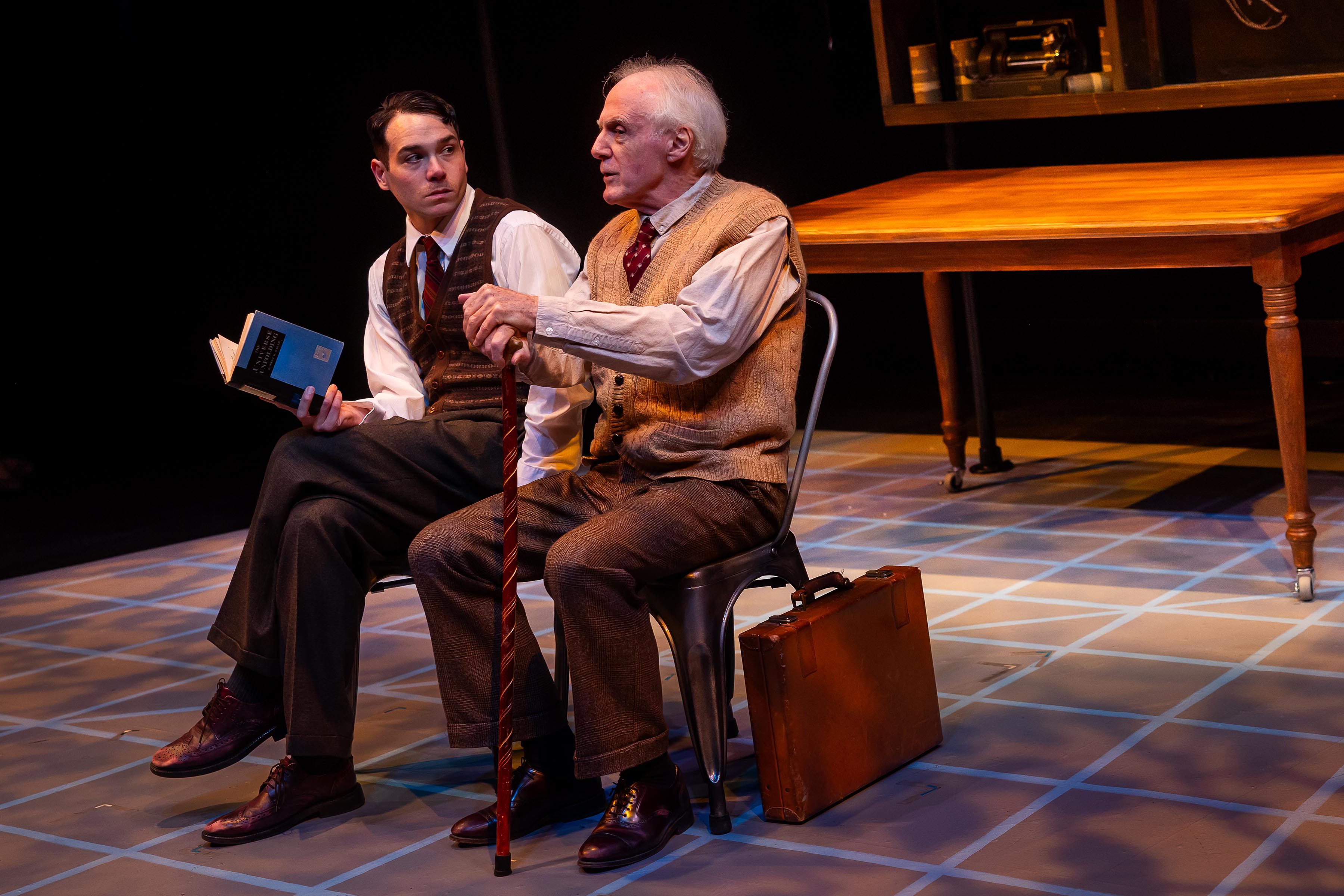
While this production boasts an excellent cast, at its center is Eddie Shields who plays Alan Turing. What I found most compelling about Shields’ portrayal was his full embodiment of a man who finds brilliance in the grand questions of the universe yet experiences profound anxiety in the interpersonal. Shields made physical choices that truly elevated a play that otherwise adds little to the known legacy of Turing.
The scenes that stood out most to me were those where Shields played opposite David Bryan Jackson as Dillwyn Knox, my absolute favorite of the cast. Jackson provided a perfect foil to Shields’ pensive Turing, offering a performance that was relaxed, authoritative, and yet fatherly in its tenderness.
Throughout the show, Turing is interrogated for “gross indecency” by Mick Ross, played even-handily by Dom Carter. Carter serves as a perfect anchor for the shows recurring scenes, especially in the stellar interrogation staging of Act 2 — despite his accent being inconsistent at times. During moments of flashbacks/forward, I found myself wanting more from the transitions; many moments ended abruptly on a blackout following a line, missing an opportunity for the technical and lighting design to further bridge the narrative. A notable exception was the “People of your sort seldom are” segment, which integrated a brilliant lighting cue that provided the kind of cohesive transition I found myself craving elsewhere.
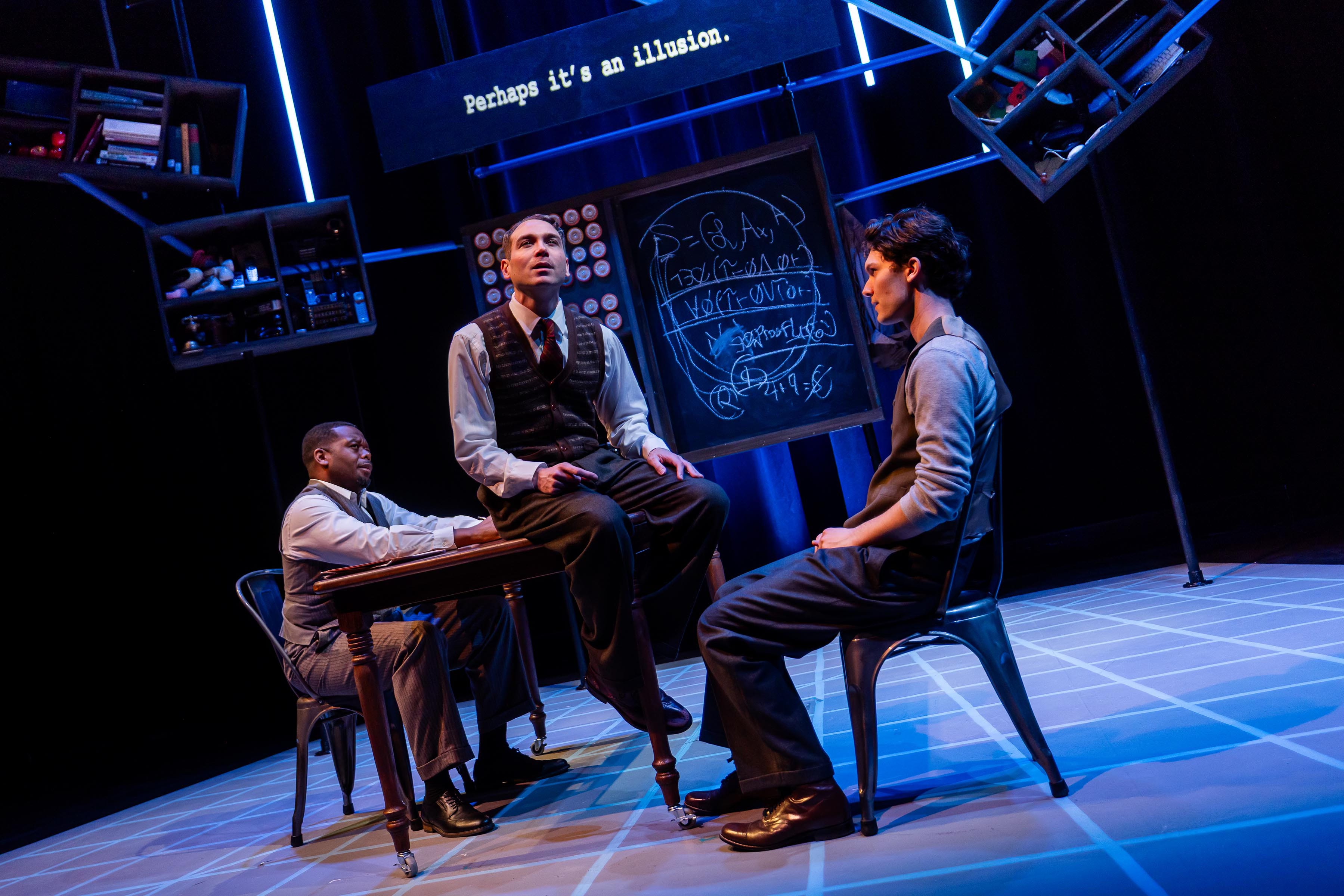
Rounding out the cast are the inimitable Paula Plum as Sara Turing, the versatile Josephine Moshiri Elwood as Pat Green (both of whom sport some of the production’s best costumes by Chloe Moore), and Matthew Beagan, who plays multiple characters. Plum brings a familiar matronly humor to the role of Sara Turing, which is on perfect display during an exchange in which she attempts to convince Pat to accompany her to church in an effort to set her up with Alan. Throughout, Elwood reminds us just how versatile she can be, giving a tender performance that ranges from deep devotion to a bittersweet acceptance of Alan’s sexuality, which was a welcome balance to the plays heavier content.
Beagan—an actor I first encountered in Boston University’s sublime 2024 production of Sunday in the Park with George — impressed by sporting multiple accents with enough specificity to sell each of the four characters he portrays. One scene that stands out in particular features Beagan as Nikos, a Greek man Turing spends time with abroad. As the two share an exchange partially lost in translation, their intimacy truly shines (Liv Dumaine, Intimacy Director), helping us see just how desperate Turing had become for connection later in life. Later Began transforms into a current day student, and delivers the plays final speech which serves as a beautiful tribute to both Turing and the enduring resiliency of queer folks everywhere.
While I didn’t walk away from this production with new information about Turing’s life and legacy, I did leave feeling more connected to the man behind the legacy. The standouts of this production are the exceptional cast, its staging, and the evocative lighting design, which brought such weight to each scene that the final moments landed with a profound sense of reverence. Overall, this is a moving look into Turing’s life, and a recognition that Turing did not die in defeat, but lives on in so many tangible ways.
Breaking the Code is playing at Central Square Theater in Boston Massachusetts through May 3rd.