

A friend and I were recently discussing the insidious ways corporate greed and rapid modernization have warped how we engage with media and one another. What began as the intoxicating promise of having entire artistic libraries at our fingertips [Netflix, Hulu, Disney+, etc] has devolved into a fractured nightmare of tiered paywalls, where the one show you hope to watch is abruptly pulled and sold away to a rival streaming platform. Modernization inevitably brings change and excitement, but what does it leave in its wake? This very question is explored through the culturally rich lens of a family-run pho shop in CHUANG Stage’s spirited production of Minna Lee’s My Home on the Moon, directed by cara hinh.
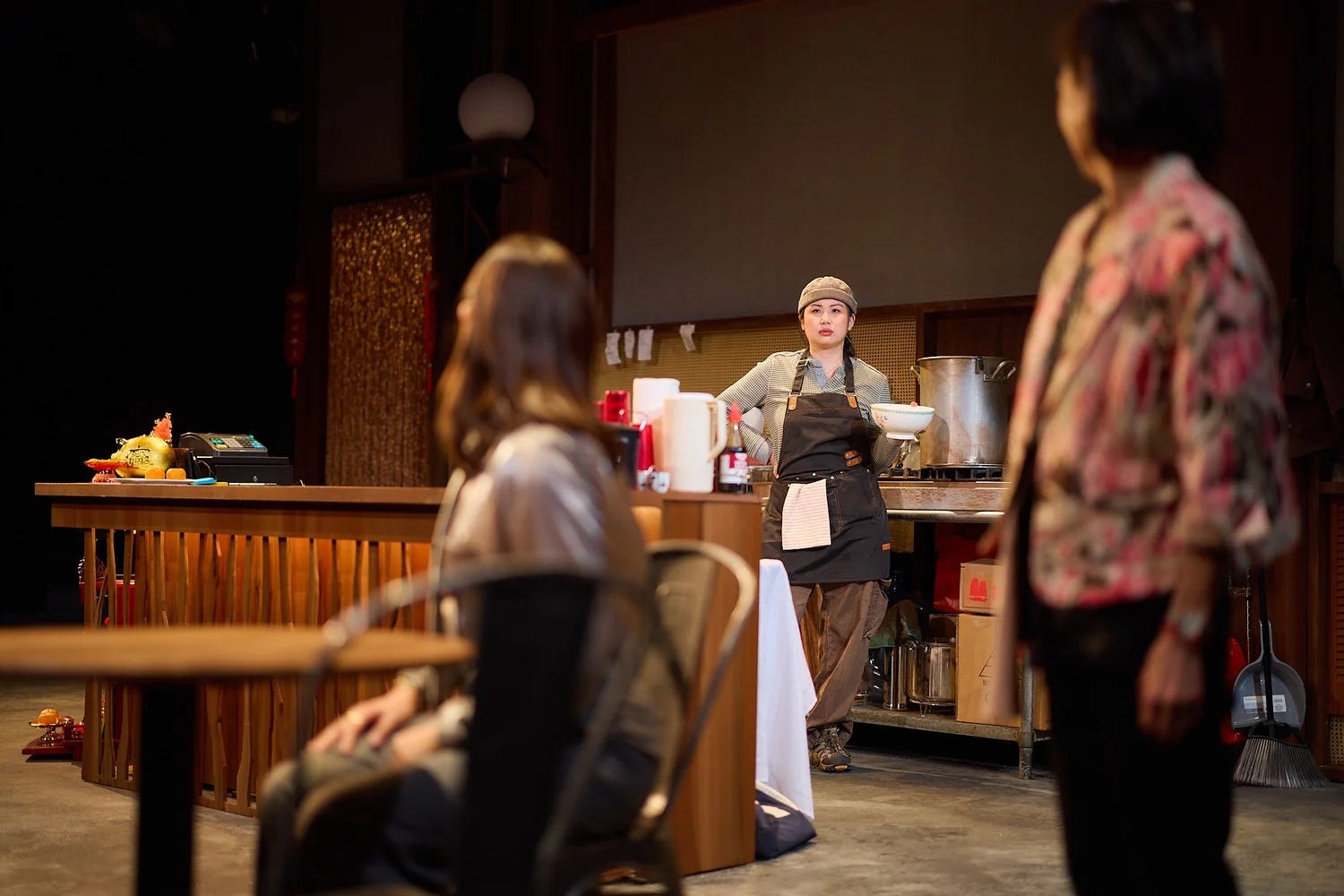
My Home on the Moon follows mother Lan and daughter Mai as they struggle to keep their family-run pho shop, Pho Lan, afloat while watching neighboring storefronts get bought up and razed to the ground in favor of new corporate developments. After being approached by Vera—a polished, unflinching, yet strangely robotic company representative—the two decide to partner with Novus Corp, under the impression that they will retain full creative and operational control of their beloved restaurant. As business booms thanks to Vera’s uncanny analytical acumen, a shocking revelation regarding her true nature and the secretive corporation forces the family to face a devastating choice: sell out entirely, or risk everything to honor their legacy. Clocking in at a tight 90 minutes, this production is rife with humor, standout performances, and beautiful Vietnamese cultural representation.
Before ever entering the theatre, patrons were wowed by an exciting lion dance performed by Gund Kwok of Boston, an Asian Women’s Lion and Dragon Dance Troupe. Upon entering the black box space, audiences are greeted by Qingan Zhang’s lovely scenic design, which nails the specific vibe of an urban pho shop to near perfection. Many of Zhang’s details are particularly notable: the wooden see-through construction of the bar counter and the beautifully worn, well-loved look of the kitchen pots and accessories. Yet one that stood out to me most is the Cafe du Monde coffee can perched on an upper kitchen shelf—a subtle, poignant nod to the Vietnamese immigration experience and the historic use of chicory coffee to recreate the deep, robust flavors of Vietnamese coffee beans. As a Louisianian, I deeply appreciated this unexpected cultural intersection and the intentionality behind its inclusion.
From the start, I found myself thoroughly endeared to Belle Le’s portrayal of Mai. As Lan’s daughter, Mai initially presents as rather guarded and grungy, yet underneath that exterior lies a curious, endearing awkwardness that Le captures with beautiful balance and emotional breadth. Her scenes opposite Christina R. Chan are particularly notable for their grounded relatability; the two have perfectly mastered the intricate friction of the mother-daughter relationship, capturing all its inherent pressures, responsibilities, quirks, and deep affection. While Chan’s portrayal effectively exemplifies a more laid-back, cool-Mom archetype, her comedic timing occasionally felt inconsistent across her performance. Meanwhile, in her scenes opposite an outstanding and chillingly consistent Emma Na-yun Downs as Vera, Le deftly reveals yet another layer of Mai’s heart: a vulnerable desire to be seen, loved, and validated in her queerness.
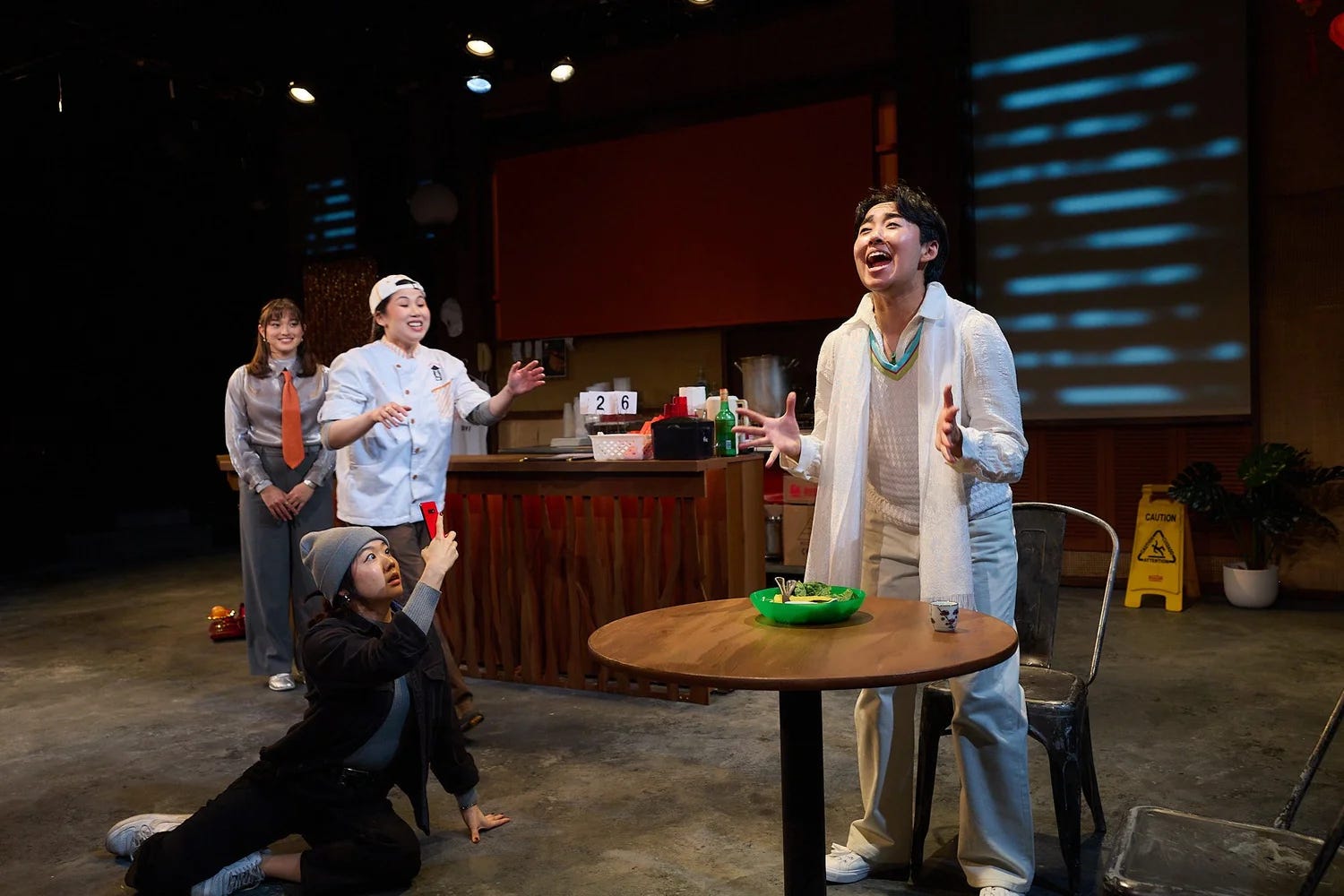
Following the fateful agreement with Novus Corp, the production is infused with dynamic energy by ensemble members Lee Baladejo and Jenny S. Lee. Baladejo plays two characters, Beau—a former Pho Lan employee and later a hyper-enthusiastic food influencer—while Lee plays a photographer, and then Gigi, a leader within the Novus Corp who dons two dress suits that are as sinister and evocative as her portrayal (Eric Tran, Costume Designer). During Baladejo’s scenes as a food influencer, I was reduced to tears of laughter by the sheer absurdity and precision they brought to the role. A remarkably nimble Lee shadowed them closely, diving completely to the ground with her cellphone to snap the perfect photo—a bit of physical comedy that had the entire theater in uproarious laughter. Their brilliant, comedic chemistry is also on display during a corporate commercial that airs for the Pho Lan rebrand, leaving the audience in a state of absolute, hysterical shock (supported by Qingan Zhang’s projection design and Kat C. Zhou’s lighting design).
When a shocking twist unmasks the true nature of Novus Corp through Vera, it is revealed that Pho Lan is entirely a simulation. This sequence was my favorite of the evening and marked a high point for the creative team. Qingan Zhang’s scenic design and Kat C. Zhou’s lighting design worked in brilliant tandem, creating optical depth and dimension where none previously existed—an illusion so seamless I’m still not entirely sure how they pulled it off. This pivotal moment handles the script’s sharp pivot from situational comedy to speculative sci-fi quite nicely.
Yet, because the physical set remains unchanged, the heavy lifting of this tonal shift falls squarely on the atmosphere. While Zhou’s lighting supported the transition beautifully, Hien Nguyen’s sound design left room for a more robust atmospheric shift to match the gravity of the revelation. I felt a similar lack of sensory support during the surreal moments when Mai and Lan interact with a galactic pho noodle, and when the cast members “glitch” as they are pulled through time dimensions by Novus Corp’s manipulation; the physical stuttering of the actors didn’t quite carry the scene on its own. A more immersive tapestry of sound and lighting effects could have elevated these high-concept moments. Ultimately, this pointed to the production’s largest missed opportunity: I never felt as though we actually left the space, but rather that something extraterrestrial was implied.
Ultimately, while there are a few missed production opportunities, CHUANG Stage’s production remains a worthwhile endeavor for its humor, striking projection design, and timely message. By the play’s end, audiences are left sitting with the same unsettling question that Vera poses to Mai and Lan: Do you cling to what’s comfortable at the cost of your own slow destruction, or do you stand firmly by your values for something far greater than corporate greed could ever buy?
My Home on the Moon is playing at CHUANG Stage at Boston Center for the Arts in Boston Massachusetts through June 13th.